OpAMP Protocol Sequence
OpAMP protocol execution flow and callback sequence
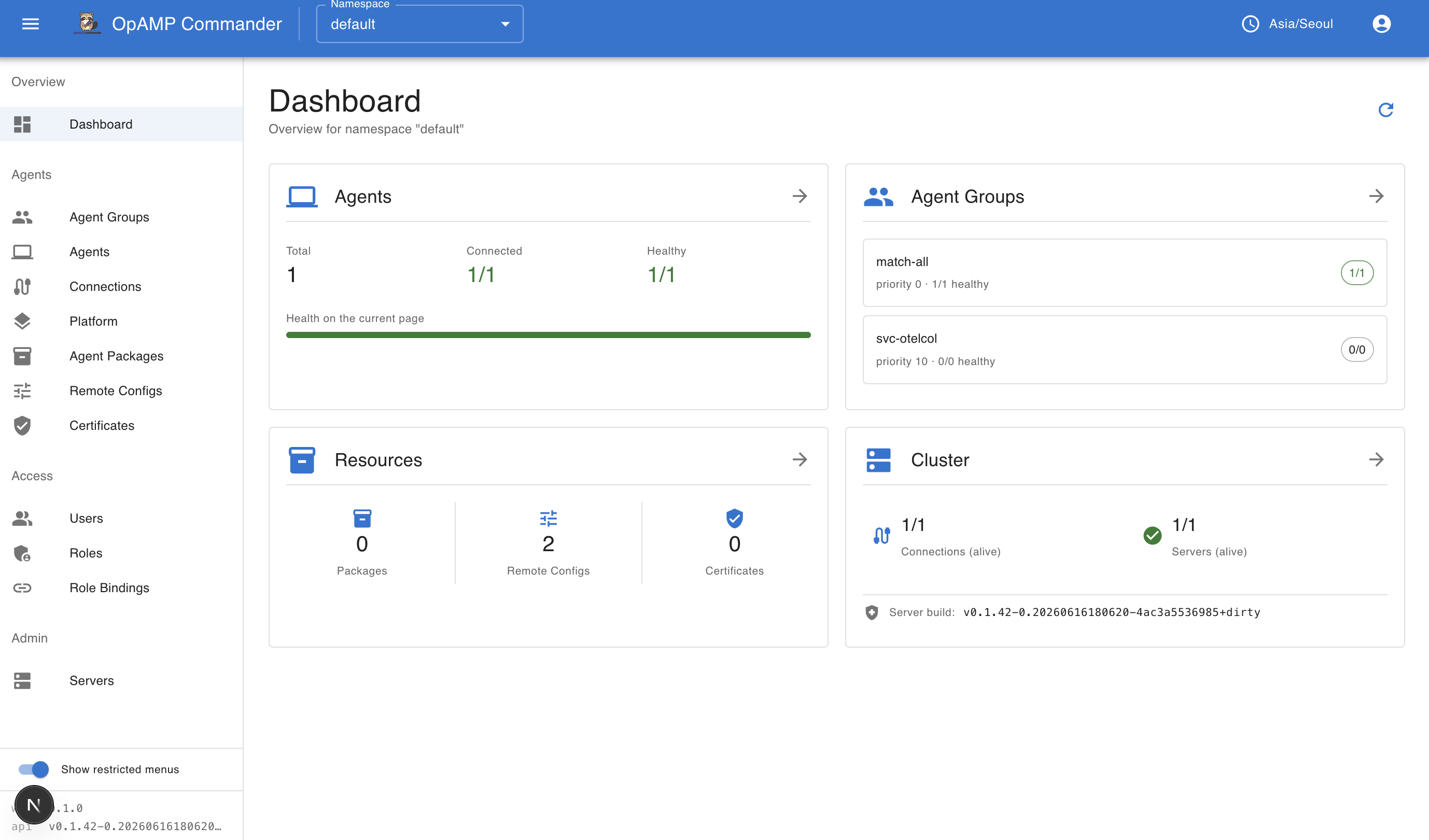
OpAMP Commander is a management platform for OpenTelemetry agents that implements the Open Agent Management Protocol (OpAMP). It provides a centralized way to manage, monitor, and remotely configure distributed telemetry collection agents.
| Component | Description |
|---|---|
| apiserver | Hosts the OpAMP WebSocket endpoint agents connect to, and a REST API for management. |
| opampctl | A kubectl-style command-line client. |
| web | A Next.js + MUI dashboard. |
Services must remain stateless and contain business logic and operation orchestration. This rule applies to all resources, including agents, connections, certificates, agent groups, namespaces, hosts, containers, applications, users, and RBAC resources.
| Responsibility | Owner |
|---|---|
| Business rules and operation orchestration | Service, using domain models to validate state transitions |
| Resource and session state, including active connections and liveness | Store |
| Caches, indexes, TTL, cloning stored values, and cache invalidation | Store |
| Storage synchronization, version checks, and conditional updates or deletes | Store implementation |
A Service may hold injected dependencies, such as Store ports, a logger, or a clock, and immutable configuration. Per-operation variables remain local to the operation. Mutable resource or session state shared between operations must be owned by a Store rather than a Service.
Store interfaces are domain ports, and their implementations belong in secondary
adapters. A Store may use memory, MongoDB, Redis, or a cache over another Store.
Basic resource access uses the generic Reader[K, V] (Get) and Store[K, V]
(Get, Put, Delete) ports. Resource-specific Store interfaces embed these
contracts and add the operations they need, such as fresh reads, selector queries,
or conditional session deletion. Version checks and cache behavior remain in the
implementations; a generic interface does not make writes unconditional. Read-only
resources expose Reader without requiring unused write or delete operations.
The existing *PersistencePort interfaces already provide part of this boundary.
The OpAMP and Connection Services share a node-local ConnectionStore. It owns
live connection records, agent indexes, session synchronization, the pending
close queue, and cluster snapshot bookkeeping. The Services hold the Store port
and perform business operations within its session scope; they do not own those
maps, queues, or mutexes.
Services rely on atomic Store operations with an expected resource version or session identity when a state transition requires it. Store implementations encapsulate the mutexes or conditional database writes needed for those operations. Guarantees spanning multiple Stores must be defined explicitly; separate thread-safe methods alone do not make a whole workflow atomic.
Agent and Server Services use read-through Stores over their persistence ports. The Stores own cache TTL, capacity, cloning, invalidation, and shutdown. Fresh agent reads bypass the cache when a deletion decision must observe other writers.
The notification Store owns per-server pending UID sets, early-flush signals, and the dispatch queue. The agent-group change Store queues namespace/name values and isolated copies of the affected selectors; the Service reloads the current configuration while still visiting the original members after a selector change or group recreation. These queues are node-local and best-effort: durable agent messages and the periodic group reconcile remain their recovery paths. Worker lifetime tracking is local to each Service Run invocation, not shared resource state.
graph TB
    subgraph Clients
        CLI[opampctl CLI]
        WebUI[Web Dashboard]
    end
    subgraph Agents
        Agent[OpenTelemetry Collectors<br/>OpAMP agents]
    end
    subgraph Server["OpAMP Commander"]
        API[apiserver]
    end
    DB[(MongoDB)]
    MQ[[Kafka<br/>multi-node only]]

    CLI -->|HTTP/REST| API
    WebUI -->|HTTP/REST| API
    Agent <-->|OpAMP over WebSocket| API
    API -->|persist| DB
    API <-.->|server-to-server events| MQ

    style API fill:#4a90e2,stroke:#333,stroke-width:2px,color:#fff
    style DB fill:#6c757d,stroke:#333,stroke-width:2px,color:#fff
    style CLI fill:#28a745,stroke:#333,stroke-width:2px,color:#fff
    style Agent fill:#ffc107,stroke:#333,stroke-width:2px,color:#000
style WebUI fill:#17a2b8,stroke:#333,stroke-width:2px,color:#fffsequenceDiagram
participant Agent as OpAMP Agent
participant Server as apiserver
participant DB as MongoDB
Agent->>Server: Connect via WebSocket
Server->>DB: Store agent info
Server->>Agent: Send remote configuration
Agent->>Server: Report status / effective config
Server->>DB: Update agent stateWhen an agent is connected to server B but server A receives a management request, server A publishes an event to Kafka and server B’s consumer delivers it over the agent’s WebSocket. In single-node (standalone) mode an in-memory event bus replaces Kafka.
sequenceDiagram
    participant CLI as opampctl
    participant A as apiserver A
    participant MQ as Kafka
    participant B as apiserver B
    participant Agent as Agent (connected to B)

    CLI->>A: Management request
    A->>MQ: Publish event
    MQ->>B: Deliver event
B->>Agent: Push over WebSocketReady to start? See the Getting Started Guide for installation and setup.
OpAMP protocol execution flow and callback sequence
Was this page helpful?